
If you’ve ever attended a Filipino family party, you already know the drill. Somewhere between the second plate of lumpia and the cutting of the cake, a microphone is turned on. It doesn’t matter if it’s a living room in Manila, a backyard in California, or a flat in London—somebody’s uncle is about to perform a flawless rendition of a Michael Bolton classic, and a seven-year-old is going to casually belt out Whitney Houston.
It’s almost a global running joke at this point: Filipinos can sing.
For decades, artists of Filipino descent—from Lea Salonga and Arnel Pineda to Bruno Mars and H.E.R.—have dominated global stages. Now, as of 2026, we are watching the massive global explosion of P-Pop groups like SB19 and BINI, proving that this vocal prowess isn’t a fluke of the past, but a constantly evolving force.
But why? Is there a specific “birit” (belting) gene? Are vocal cords just built differently in the archipelago?
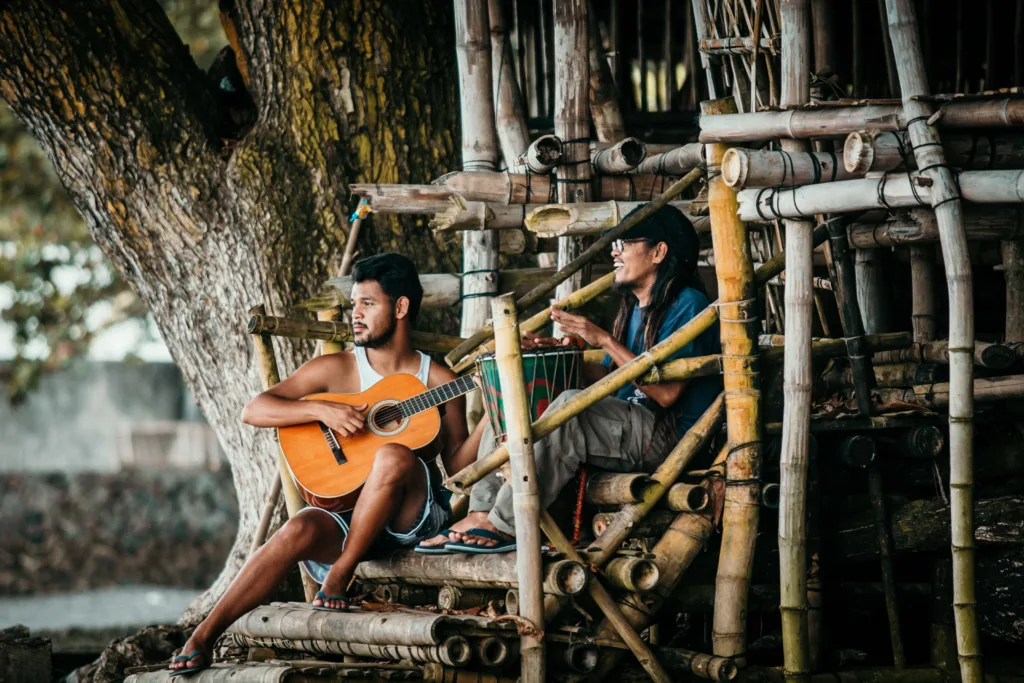
Photo by James Ampong Quilario – Pexels
The reality is far more interesting than genetics. The Filipino vocal powerhouse phenomenon is a perfect storm of linguistics, history, emotional resilience, and an environment that treats music like a second language. Let’s break down exactly what makes Filipinos such naturally gifted singers.
1. The Linguistic Head Start
One of the most overlooked reasons for Filipino singing ability lies right in their mouths. The structure of Philippine languages, particularly Tagalog and Bisaya, provides a natural, everyday vocal warm-up.
Tagalog relies heavily on open, relaxed vowels and soft consonants. Unlike English, which features many hard stops and complex consonant clusters that tighten the throat, Filipino words naturally flow and often end on a vowel.
When you speak these languages, you are constantly lifting your soft palate and creating space in the back of your mouth—which happens to be the exact mechanical technique vocal coaches spend years trying to teach Western singers. If you grow up speaking a language that inherently shapes your mouth for optimal resonance and breath control, you already have a massive head start before you ever sing a note.
2. The 10,000-Hour Karaoke Rule
Author Malcolm Gladwell famously popularized the “10,000-Hour Rule,” stating that true mastery of any skill requires around 10,000 hours of practice. In the Philippines, kids start logging those hours before they even enter kindergarten.
While karaoke was invented in Japan, the Philippines adopted it as a way of life. The “Magic Sing” or a rented videoke machine is the centerpiece of every gathering—birthdays, anniversaries, Wednesday nights, and even wakes.
More importantly, singing in Filipino culture comes without the paralysis of judgment. In many Western cultures, people only sing publicly if they believe they are already “good” at it. If you aren’t perfectly on pitch, you are told to stay quiet. In the Philippines, the act of singing is communal. You aren’t expected to be perfect; you are just expected to participate.
Because children grow up in an environment where belting out Celine Dion or Air Supply is a normal, everyday activity, they lose the fear of performing. They learn to experiment with their vocal range, push their limits, and project their voices without anxiety.
3. A History Steeped in Melody
You can’t talk about modern Filipino music without looking at the centuries of history that shaped it. Music has always been deeply functional in the islands.
- Pre-Colonial Roots: Long before colonizers arrived, indigenous tribes used chants and rhythmic songs for everything—planting crops, bathing children, mourning the dead, and celebrating harvests. Music was never isolated; it was the soundtrack to daily survival.
- 300 Years of Choirs: When the Spanish colonized the Philippines in the 1500s, they brought Catholicism, and with it, the church choir. For over three centuries, Filipinos were trained in Western music theory, reading notes, singing hymns, and understanding complex harmonies. The traditional courtship serenades, like the Harana and Kundiman, evolved during this time, demanding deep emotion and vocal control.
- The American Influence: In the 20th century, the Americans brought jazz, blues, pop, and the English language via radio and military bases. Filipinos absorbed these Western pop structures and fused them with their own deeply emotional, romantic style of storytelling.
4. Singing as Therapy—and a Way Out
It is impossible to ignore the socio-economic realities of the Philippines. For a developing nation that has endured colonization, political upheaval, and natural disasters, music serves as an incredibly accessible coping mechanism. Singing is completely free.
Life can be difficult, but anyone can open their mouth and sing. Many vocalists note that the emotional depth required to be a great singer often stems from hardship. Singing becomes a way to release trauma, stress, and unspoken emotions.
Furthermore, singing has historically been viewed as a legitimate ticket out of poverty. The country is obsessed with singing competitions. Long before American Idol existed, local TV shows like Tawag ng Tanghalan (which started in the 1950s) offered massive cash prizes. For families with limited economic opportunities, discovering a child has a good voice means rigorous training, entering them into every barangay (neighborhood) singing contest available, and hoping their talent can provide a better future.
5. The 2026 Perspective: Beyond the “Cover Artist”
For a long time, the global perception of Filipino singers was that they were the world’s best cover artists—the people you hire to flawlessly replicate a Broadway role or front a legacy rock band.
But as we sit in 2026, that narrative has completely shifted. The rise of Original Pilipino Music (OPM) and the explosive global charting of P-Pop groups have proven that Filipino artists are no longer just replicating Western hits; they are driving the culture. The vocal training that started in a living room with a karaoke mic has evolved into highly polished, world-class artistry that commands stadium tours across the globe.
So, why are Filipinos such good singers? Because they belong to a culture that never tells them to keep their voices down.